When a tooth or several teeth are missing, the two options patients most often compare are dental implants and partial dentures. They address the same basic problem, but they work in fundamentally different ways, carry different upfront costs, and hold up differently over time.
Neither option is right for every patient or every situation. What tends to confuse is that people often compare only the initial price without accounting for what each option looks like five, ten, or twenty years down the road. A more useful comparison looks at the full picture.
At North Shore Dental Center in Peabody, Dr. Hiam Elias places and restores dental implants and also provides denture options, so patients get an honest assessment of both based on their actual clinical situation rather than a one-size recommendation.
How Each Option Works
Dental implants
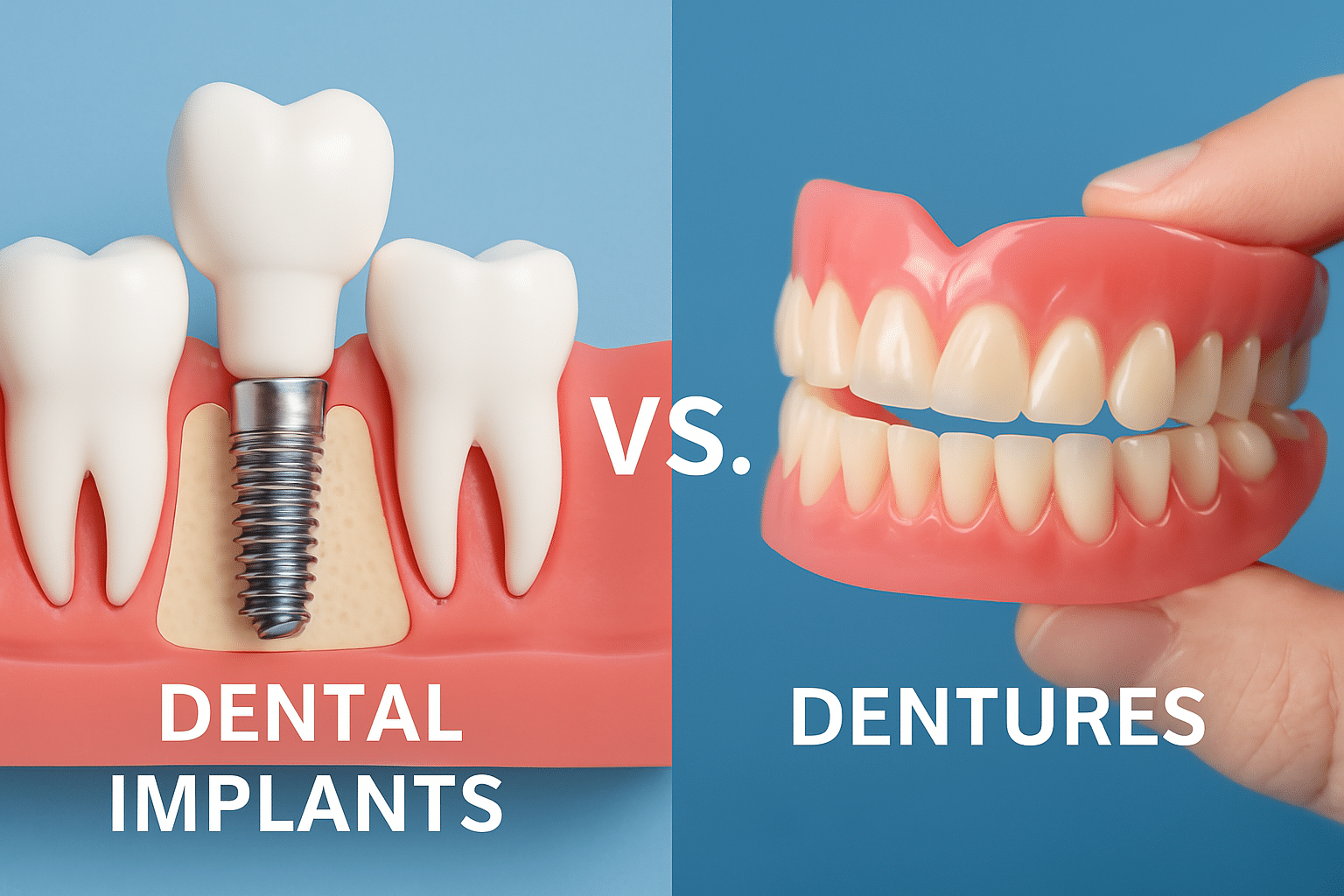
A dental implant is a titanium post placed surgically into the jawbone at the site of a missing tooth. Over several months, the bone fuses with the surface of the post through a process called osseointegration. Once that integration is complete, a crown is attached to the post, producing a tooth replacement that is fixed in place and functions independently from the surrounding teeth.
The entire process from placement to final crown typically takes three to six months, depending on healing and whether any bone grafting is needed beforehand.
Partial dentures
A partial denture is a removable appliance that uses a combination of artificial teeth and a base, either acrylic or metal-framed, that clasps onto the remaining natural teeth for support. It sits in the mouth during the day and is removed for cleaning and during sleep.
Partial dentures can be fabricated relatively quickly after teeth are lost and do not require surgery.
Comparing the Two Across the Factors That Matter
Upfront cost
Partial dentures have a lower upfront cost than dental implants. An implant requires a surgical procedure, a healing period, and then the fabrication and placement of the crown, each of which carries associated fees. The total cost per implant is typically several times higher than the cost of a partial denture replacing the same number of teeth.
For patients who are weighing their options primarily on initial expense, partial dentures often look more accessible. Dental insurance in the US sometimes covers a portion of partial denture costs, though coverage for implants is less consistent and varies significantly between plans. North Shore Dental Center can help patients review what their specific plan covers before committing to a treatment plan.
Long-term cost
The cost comparison shifts meaningfully when viewed over time. A partial denture generally needs to be relined or replaced every five to ten years as the underlying bone and gum tissue change shape. Each replacement cycle carries its own cost. Over twenty to thirty years, the cumulative expense of multiple denture replacements can approach or exceed the cost of an implant placed once.
Implants, when placed in adequate bone and maintained through regular dental care, can last many decades. The crown attached to the implant may eventually need replacement, but the implant post itself has a long functional lifespan in most cases.
The long-term cost math is not straightforward because individual factors vary considerably. But patients who are younger and expect to need tooth replacement over several more decades are generally looking at a different total investment than what the initial price comparison suggests.
Effect on bone
This is one of the most clinically significant differences between the two options and one that often doesn’t come up in the initial conversation about cost.
When a tooth is lost, the jawbone that supported it no longer receives stimulation. Without that stimulus, the bone gradually resorbs. This process begins relatively quickly after extraction and continues for years. The longer a gap is present without a tooth root in place, the more bone volume is lost in that area.
A dental implant replaces the root and transmits chewing forces into the bone, which maintains its density and volume the same way a natural tooth root does. A partial denture rests on the gum tissue and remaining teeth and does not restore bone stimulation. Bone resorption continues under a partial denture over time, which contributes to the fit changes that eventually require relining or replacement.
For patients who may want implants in the future, waiting while wearing a partial denture can reduce the bone volume available for implant placement and may make bone grafting necessary later.
Function and comfort
A dental implant functions like a natural tooth. It doesn’t move, doesn’t require removal for cleaning, and doesn’t place stress on the adjacent teeth through clasps or connectors. Patients generally report that implants feel closest to their natural teeth in terms of biting and chewing function.
Partial dentures can be effective and comfortable for many patients, but they do move slightly during function, and some patients find the clasps uncomfortable against neighbouring teeth over time. Hard or sticky foods require more caution with a removable appliance.
Comfort with partial dentures also changes as bone resorption progresses and the fit of the appliance alters. Well-fitting partial dentures that are relined or replaced on schedule tend to function better than those that are worn past their useful fit.
Oral hygiene and adjacent teeth
One consideration with partial dentures is the stress the clasps place on the natural teeth that anchor the appliance. Over time, these abutment teeth can experience accelerated wear, increased mobility, or gum irritation at the contact points.
Implants don’t attach to adjacent teeth and don’t place additional load on them. They’re self-supporting within the bone.
Cleaning around both options requires care. Implants need regular brushing and flossing like natural teeth, with particular attention to the gumline. Partial dentures need to be removed and cleaned each day separately, and the gum tissue underneath should be brushed as well.
Candidacy factors
Not every patient is an immediate candidate for dental implants. Adequate jawbone volume is needed to support the post, and active gum disease or uncontrolled systemic conditions need to be addressed before implant placement is appropriate. Patients who smoke face a higher implant failure risk and need to understand that as part of the conversation.
Partial dentures have fewer medical prerequisites and can often be placed relatively soon after tooth extraction. For patients who are not currently suitable for implants, a partial denture may be the appropriate choice now, with implants reconsidered later once conditions improve.
Dr. Elias evaluates each patient’s bone volume, gum health, and overall health history before recommending a treatment path. The goal is an honest assessment of what’s workable for that specific patient, not a default recommendation.
Which Option Makes More Sense for You
There is no universal answer. A partial denture may be the right choice for a patient who needs an accessible solution now, who has bone or health factors that make implants unsuitable, or who is replacing teeth in a lower-priority location where long-term function demands are less. An implant tends to offer more long-term value for younger patients, who are replacing teeth in areas of heavy function, and who have the bone and health conditions to support successful osseointegration.
The cases where the decision is genuinely ambiguous are real, and that’s exactly what a clinical consultation is for.
About North Shore Dental Center
North Shore Dental Center is located at 6 Essex Center Dr, Suite 302, Peabody, MA, and serves patients from Peabody, Danvers, Salem, Beverly, Lynnfield, and Marblehead. Dr. Hiam Elias, DMD, brings specialized experience in complex restorative dentistry, including surgical implant placement, crowns and bridges, dentures, and cosmetic procedures.
Schedule a Consultation at North Shore Dental Center in Peabody
If you’re weighing dental implants against partial dentures and want a clinical opinion based on your specific situation, Dr. Elias is accepting new patients at North Shore Dental Center.
Call (978) 532-0088 to book your appointment.
- Schedule a dental implant consultation at North Shore Dental Center in Peabody
- Call us to compare implants and partial dentures for your specific case
- Book an appointment with Dr. Elias at our Essex Center Dr. location
- Contact North Shore Dental Center to ask about denture or implant options in Peabody
- Request your new patient exam at North Shore Dental Center today.